 eleanor
Responsible AI
AI in Customer Support: When It Pays Off (and When It's a Waste)
AI in customer service pays off in some businesses and burns money in others. Here's what the research says about when AI pays off, when it's a waste of money, and how to run a one-week test before spending another dollar.

Every AI vendor makes the same promise: less work, faster replies, happier customers. What nobody tells you is that some businesses pay for AI that changes nothing about their month, while another business of the same size, with the same tool, answers faster and sells more. The difference isn't the model and it isn't the price: it's which task the AI was given, and what shape the operation was in when it arrived.
This article is the honest version of that conversation: what research says about AI returns, when it pays its own bill, when it's money down the drain. A one-week test can help you find out which side your business is on.
What research says about AI that doesn't pay off
The most quoted number in recent research on AI in business comes from a report by the NANDA project at the MIT Media Lab on generative AI in companies: roughly 95% of the initiatives analyzed produced no measurable return for the business. The Fortune coverage of the report adds the part that matters: the dominant cause was not model quality. It was integration. Generic tools work well for an individual working alone, but they don't adapt to the company's process or learn from it. The same survey found that buying from specialized vendors worked in about two thirds of cases, three times more often than building in-house.
Translated for a small business: the question "does AI work?" is the wrong one. The right question is "does my operation have a task AI can actually do well and will I measure it?". Where there is no clear task and no measurement, the outcome of the 95% is the expected one.
When AI in customer support pays off
The return shows up most often in four situations, all backed by research:
- The questions repeat. Opening hours, delivery time, price, address, how shipping works. The right answer already exists and is documented; the AI just needs to find it and deliver it in human language, at any hour.
- Simple volume swallows the team. In the study cited by Nielsen Norman Group, support agents with AI handled 14% more chats per hour. The detail that matters: the biggest winner was the least experienced fifth of the team, with 35% more chats resolved; the experienced barely changed. AI returns time where the operation is tightest.
- Support happens outside staffed hours. The customer writes at 10 p.m. on a Sunday; nobody will be there. A well-regulated service agent keeps the conversation alive until the team is back, without promising anything the business can't deliver.
- There is organization behind it. One inbox, customer history, documented answers. In the report's success cases, the tool fit into a process that already existed.
Notice what is not on the list: "AI sells better than people". That's not where it pays its bill in support.
When AI is money down the drain
The same research that praises also maps the dead end. Consider AI wasted when:
- Support is one phone and nobody knows what has been answered. The AI gets questions with no documented answer and makes things up. Made-up answers at scale are worse than slowness: the customer demands the promise the AI made, and the business never knew.
- The expectation is that AI closes deals and negotiates. Price, discounts, complaints, and tight deadlines are decisions that belong to the owner. A tool programmed to "handle everything by itself" is the shortest path to an angry customer and a refund.
- The volume doesn't justify it. Five chats a day, all different and consultative, need a way to stay organized. Automating five chats a day means paying to gain a new problem.
- Nobody will measure. Bought because "everyone is using it", with no defined task, no before-and-after numbers. That is the exact profile of the 95%.
Nielsen Norman Group offers a filter for this, the PROVE framework: evaluate AI on one specific task (not on the abstraction of "AI in general") and treat the result as a provisional decision, never an eternal verdict. The core criterion is simple: it pays off by what it changes in the total time of the work, not by how pretty the demo was.
The one-week test that separates a bet from a return
Before expanding AI to everything, run a narrow test, in the spirit of PROVE, adapted for anyone without a tech department:
- Pick one task only: the most repeated question of last week (hours, delivery time, catalog).
- Measure before: how many chats of that type arrived, how long the first reply took, how many went unanswered.
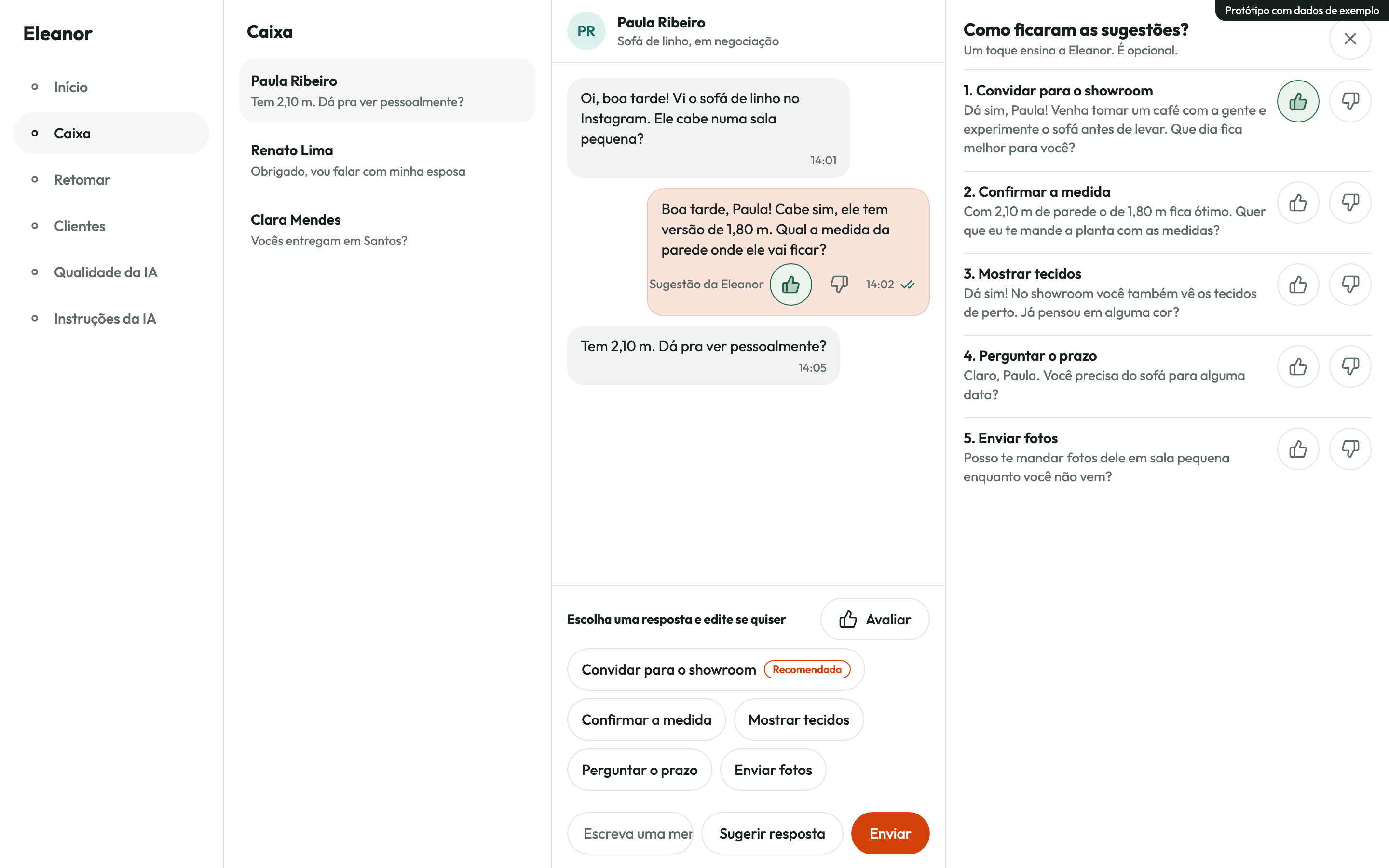
- Turn AI on for that task only, with the business rules written down and the "answers on its own" mode restricted to the chosen topic.
- Run it for a week and review what the AI replied. Zendesk's research with more than 7,500 support leaders shows 87% agree that verification must be embedded in AI-led interactions; reviewing is part of the job.
- Grade it from 1 to 5 on the question "what did this change in the total time of support?", where 3 equals the old way. A 4 or 5: expand to the next topic. A 3: adjust the rules and run it again. A 1 or 2: turn it off and fix the organization first.
A week like this costs little and answers the question of this article with your business's numbers, not a vendor's promise.
Why at Eleanor the test never becomes a bet
You subscribe to the platform; for the AI, the model, the consumption and the spending cap are yours. That changes the risk of the test: instead of buying an expensive bundle "with AI included" and hoping, you switch the service agent on for the chosen task, with your own account key, a cap you approved, and a pause button one click away. If the test grades low, the cost was one week and a few thousand tokens. That'sthe price of an informed decision, not of an annual bet.
And a high grade changes one thing and not another: the cap is still yours. The business decides where and how much AI to use, with the bill in the open.
Next steps
AI in customer support pays off when there are repeated questions, volume squeezing the team, hours with no staff and organization behind it. It's money down the drain when it arrives at a messy operation told to "handle everything", with no measurement and expectations of a miracle. A one-week test on a single task tells you which side you're on.
Build a plan the size of your business: WhatsApp numbers, people on service and contacts, with or without AI.
Answers on this topic
Frequently asked questions
When does AI in customer support pay off?
When questions repeat and have documented answers, when simple volume consumes the team, when messages arrive outside staffed hours, and when there is organization behind it: one inbox, history and written rules. In those cases research shows real productivity gains, strongest precisely where the team is less experienced.
When is AI in support a waste of money?
When it lands in a messy operation with no documented answers (and starts making things up), when the expectation is that it negotiates and decides alone, when daily volume is small and consultative, and when nobody will measure before and after. That is the portrait of most initiatives that show no return.
How do I test AI in support without wasting money?
Pick one repeated task, measure the scenario first, turn AI on for that task only with written rules, run it for a week while reviewing the answers, and grade from 1 to 5 what changed in the total time of support. High grade, expand; low grade, turn it off and organize the house first.
More articles

Your AI's House Rules Matter More Than the Model Behind It
Two businesses run the same AI model; one gets praise, the other sees the AI promise deadlines nobody approved. The difference is the instructions the owner wrote. What OpenAI and Anthropic say about rules, and the minimum set every support AI needs.
Read article

How Much Does a Support AI Cost? The 3 Cost Layers Nobody Explains
Anyone who asks 'how much does a support AI for WhatsApp cost?' hears 'it depends', with no explanation. The bill has three layers: the channel (WhatsApp), the platform that organizes, and the AI usage itself. See what drives each one and the questions to ask before you sign.
Read article
Your AI Cost in Your Hands: Why Pay-Per-Use Changes the Game
AI can come bundled into the package or charged per use, on your own key. The second model changes the owner's decision: the model, the consumption and the spending cap become yours. Where, when and how much to use AI becomes a business choice, not a contract clause.
Read article