 eleanor
Cost breakdown
How Much Does a Support AI Cost? The 3 Cost Layers Nobody Explains
Anyone who asks 'how much does a support AI for WhatsApp cost?' hears 'it depends', with no explanation. The bill has three layers: the channel (WhatsApp), the platform that organizes, and the AI usage itself. See what drives each one and the questions to ask before you sign.

Every business owner who researches "how much does an AI for WhatsApp cost?" gets the same vague answer: "it depends". Depends on what? Nobody explains. That's how the plan "with unlimited AI included" wins the deal, right up until the invoice arrives or the cap shows up in the middle of a sales week. The problem isn't anyone's price; it's that the question was asked as if support AI were one number. It isn't. It's three layers. If you don't separate them, you can't compare vendors, forecast the bill, or decide where to save.
This article takes the three layers apart, shows where the cost usually hides, and ends with the questions to ask any vendor before signing.
Why nobody can tell you the price
Because the market learned to bundle the three layers into a single package. You buy "customer service with AI" and you never see channel, platform and usage separately. You see a monthly fee and a promise. Comparing two packages like that is comparing two black boxes: the cheaper one may be paying for itself with a weak model, a tight cap nobody mentioned, or a channel that isn't even the official API.
The NANDA project report at the MIT Media Lab found roughly 95% of AI initiatives in companies produced no measurable return and Fortune's coverage points to the dominant cause: integration, not model quality. An opaque purchase produces exactly that: the tool arrives, doesn't fit the process, and the fee keeps running. Research on service mindset summarized by Sebrae, Brazil's small-business agency, adds the other side: no competitive advantage survives bad customer service. Support spending deserves an open bill.
Layer 1: the channel, WhatsApp's official API
Every customer conversation on WhatsApp that goes through a system travels on Meta's official API. And this layer has an owner: Meta charges per business-to-customer message delivered. Messages the customer sends to the business cost nothing. The rate changes with the message category (marketing, utility, authentication and service) and the customer's country, and some messages cost nothing: conversations the customer opened inside the service window and a monthly franchise of service messages per number.
This layer is the same for every serious vendor: every system on the official API pays Meta for the same messages. If a quote seems to ignore that cost, it's hiding in layer 2. And whoever doesn't use the official API doesn't have this layer: they have another problem, because a tool operating outside Meta's rules puts the business's number at risk of being blocked. The official WhatsApp Business Platform page describes the channel that exists for companies.
Layer 2: the platform that organizes
The second layer is the software that turns conversations into customer service: one inbox with an owner per conversation, the customer profile next to the chat, a funnel with stages, centralized history, canned answers and alerts for whatever goes quiet. This layer is charged by subscription, usually by the size of the operation: WhatsApp numbers, people on service, customers.
This is where vendors compare honestly, because the right question changes from "how much does it cost?" to "what's included?". And notice: none of this is AI. The platform works completely without any AI; the AI (layer 3) comes in as acceleration on top of the organization, not as the foundation.
Layer 3: AI usage, models and tokens
The third layer is the AI consumption itself. A service agent reads the conversation and writes the reply using a language model, and these models charge by token, the unit of text the AI reads and produces. The price changes by model and provider, and each one publishes its own table: OpenAI, Anthropic and Google are the starting points. A typical support conversation consumes a few thousand tokens. That costs pennies when you can see the usage and can come as a surprise when bundled.
There are two schools:
- AI bundled into the package: the vendor buys model consumption wholesale, embeds it in the price and resells it as "AI included". You don't know which model, you don't see the usage, you don't control the cap. When costs squeeze the vendor, the cap goes down and it goes down on you.
- Platform and AI kept apart: the owner picks the model, connects their own key, sees the consumption of every reply and sets the spending cap. The subscription pays for the platform; AI usage is billed by the model provider, on the business's own key.
Red flags when buying
With the three layers in mind, the warnings become obvious. Be suspicious when:
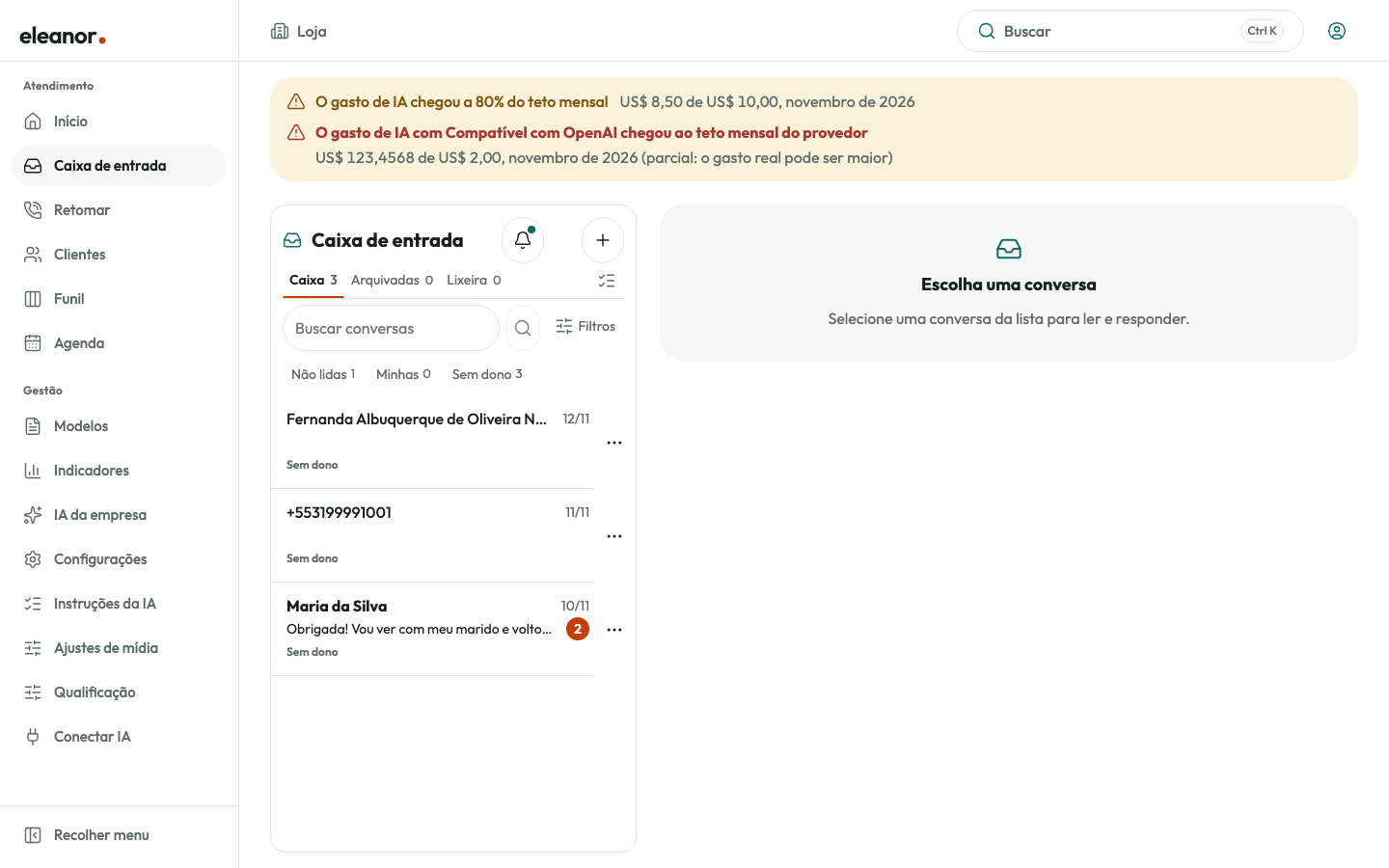
- They say "unlimited AI" without explaining the model or the cap. A language model costs by usage; "unlimited" without numbers is a slogan. Either the usage is tiny, or the cap exists and shows up later.
- The price is one number "with AI included" without saying how much is channel, how much is software and how much is model consumption.
- There is no usage report and no pause button. If you can't see what the AI spent and can't switch it off on a Tuesday afternoon, the control belongs to the vendor, not you.
- The channel is not the official API. The absence of Meta's charges looks "cheap", but the business's number is hostage to an operation outside the rules.
The questions that close the comparison
Take these five questions to any sales conversation. The answers separate a transparent vendor from a black box:
- Is the channel Meta's official API? If not, stop there: the business's number is at risk.
- Which AI model answers my customers? "An AI model" is not an answer; the model's name and provider are.
- Who pays for the usage, and where can I see it? Own key with a usage report, or bundled consumption with no visibility?
- Is there a spending cap that I define? And what happens when it's reached?
- Can I pause the AI or change models without changing platforms? If the AI is locked to the contract, you didn't buy a layer. You bought a nest.
Nielsen Norman Group gives the final criterion: test the AI on one specific task and compare the total time of the work with and without it, on a 1-to-5 scale where 3 means "same as the old way". With the layers kept apart, that test costs one week of real usage.
Next steps
Support AI cost isn't one number: it's a channel charged per delivered message, a platform charged by subscription, and AI charged by usage. Whoever gets the three layers separated in the proposal compares on equal terms, forecasts the bill, and decides where to use AI and where not to.
Eleanor separates the three layers by principle: official API on the channel, subscription for the size of your operation, and AI with your own key, usage and cap.
Answers on this topic
Frequently asked questions
How much does an AI for WhatsApp cost?
The bill has three layers: the channel (Meta charges per business message delivered, by category and country), the platform (a subscription sized to the operation) and AI usage (models and tokens, billed by the provider). Without the three layers separated in the proposal, no price comparison is honest.
Why is "unlimited AI" a red flag?
Because every language model costs by usage. "Unlimited" with no model and no cap declared means bundled, invisible consumption: either the real usage is tiny, or a limit shows up later. Hidden cost is not absent cost.
Can I pay only for the AI I actually use?
Yes, in the model where platform and AI stay apart: you subscribe to the platform and connect your own model key, with visible consumption per reply, a cap you define and a one-click pause. The AI bill becomes proportional to what you authorized it to handle.
More articles
AI in Customer Support: When It Pays Off (and When It's a Waste)
AI in customer service pays off in some businesses and burns money in others. Here's what the research says about when AI pays off, when it's a waste of money, and how to run a one-week test before spending another dollar.
Read article

Your AI's House Rules Matter More Than the Model Behind It
Two businesses run the same AI model; one gets praise, the other sees the AI promise deadlines nobody approved. The difference is the instructions the owner wrote. What OpenAI and Anthropic say about rules, and the minimum set every support AI needs.
Read article
Your AI Cost in Your Hands: Why Pay-Per-Use Changes the Game
AI can come bundled into the package or charged per use, on your own key. The second model changes the owner's decision: the model, the consumption and the spending cap become yours. Where, when and how much to use AI becomes a business choice, not a contract clause.
Read article