 eleanor
AI costs
What does it cost to run AI in your customer service? Tokens explained for business owners
AI for customer service is billed by tokens, a unit most sellers never explain to business owners. Input and output, caching and batching, what a typical conversation consumes, and how to price your own operation before signing anything.

Everyone selling AI for customer service talks about messages, bots and "plans with AI included". Almost nobody explains how AI is actually billed (by token) and what that means for your business's cost at the end of the month. This article explains it in everyday language: what a token is, why input and output are priced differently, what makes consumption go up and down, and how to estimate the cost of your own operation before signing anything.
What a token is
A token is the piece of text AI models use to read and write, such as a word, a piece of a word or a punctuation mark. The model doesn't read "customer" in one bite; it reads in pieces. Everything that goes in (the customer's question, the business's instructions, the conversation history) and everything that comes out (the AI's answer) adds up to a token bill.
Picture a shop where the AI can only speak in tokens: every phrase it reads costs a handful of tokens, every answer it writes costs another. The more context you give it to work well (house rules, catalog, history) the more it reads per answer. The metaphor breaks on precision (there is no fixed-size token), but it lands the essential point: the bill is per piece of text processed, not per message. The providers set the price of those pieces: OpenAI, Anthropic and Google publish tables per token, split by model and, as we'll see, by direction too.
Input and output are priced differently
The bill has two parts, and many people only discover that on the invoice:
- Input: what the model reads to write an answer: the customer's message, the business's rules, the history. It is the heavier side of the bill, because the history gets read again on every new message of the conversation.
- Output: what the model writes. It costs more per token than input (writing demands more work than reading) but in customer service it is usually the smaller slice, because replies are short.
The practical consequence: one long conversation costs more than two short ones, even with the same total number of messages, because the accumulated history is re-read on every round.
Caching and batching: the same work for less
The official tables have two lines that are gold for customer service and almost never mentioned:
- Prompt caching: when the same opening chunk (the business's instructions, for example) repeats from conversation to conversation, the provider can charge the cheaper re-read instead of processing everything again. Stable, well-written instructions turn into a discount.
- Batching: tasks that don't need to happen in real time (summarizing the day, tagging contacts, transcribing old voice notes) can be sent in a batch, at cheaper prices. In customer service, almost everything that is not "answer right now" is a batch candidate.
Neither line changes what the AI does; it only changes the price of the same work. OpenAI, Anthropic and Google explain caching and batching on their pricing pages, with the current discounts for each model.
What a service conversation actually consumes
Honestly: a typical conversation (catalog questions, delivery time, shipping, a few messages to close) consumes a few thousand tokens in total, reading and writing combined. Not millions. What pushes the number up is not the number of customers; it is the weight of each round:
- Long history: a two-hundred-message conversation costs far more per round than a ten-message one, because everything gets read again.
- Large instructions and catalogs repeated on every answer.
- A pricier model: the same question costs differently on different models.
- Extra work: transcribing audio, summarizing conversations and analyzing images add to the bill.
The implication is good: in customer service, typical usage is modest. The scary invoices you hear about usually come from other workloads (processing documents in bulk, for example), not from answering customers on WhatsApp with well-written rules.
How to price your own operation (no guessing)
You don't have to take anyone's word, not even ours. One week with a spreadsheet settles it:
- Take a real week of conversations and count the service rounds (a round = the customer writes, the AI would answer).
- Estimate each round: the customer's message + the business's instructions + the history + the expected answer: on WhatsApp, a few hundred words per round.
- Convert to tokens using the provider's own guidance (OpenAI, Anthropic and Google explain how, on their pricing pages and docs).
- Multiply by the official tables of the model you would choose, separating input and output and checking the caching lines.
- Compare models: the same math on the cheapest and the most expensive model usually answers the question "do I need the top-tier model to serve customers?".
Whoever does the math understands what matters: the cost depends on the business's choices (instruction size, model, how much history goes in) not on a closed number imposed by someone else.
Two billing models: AI bundled in the plan, or AI on your own key
There are two ways the market bills AI customer service, and they differ in how much of the bill you can see:
- AI bundled in the plan: the vendor resells AI inside their plan, with a closed price per message or per "bot credits". Simple to buy, opaque to audit: you don't know which model is running, what each conversation really cost, or what happens to your usage as the business grows. When usage spikes, the upsell appears.
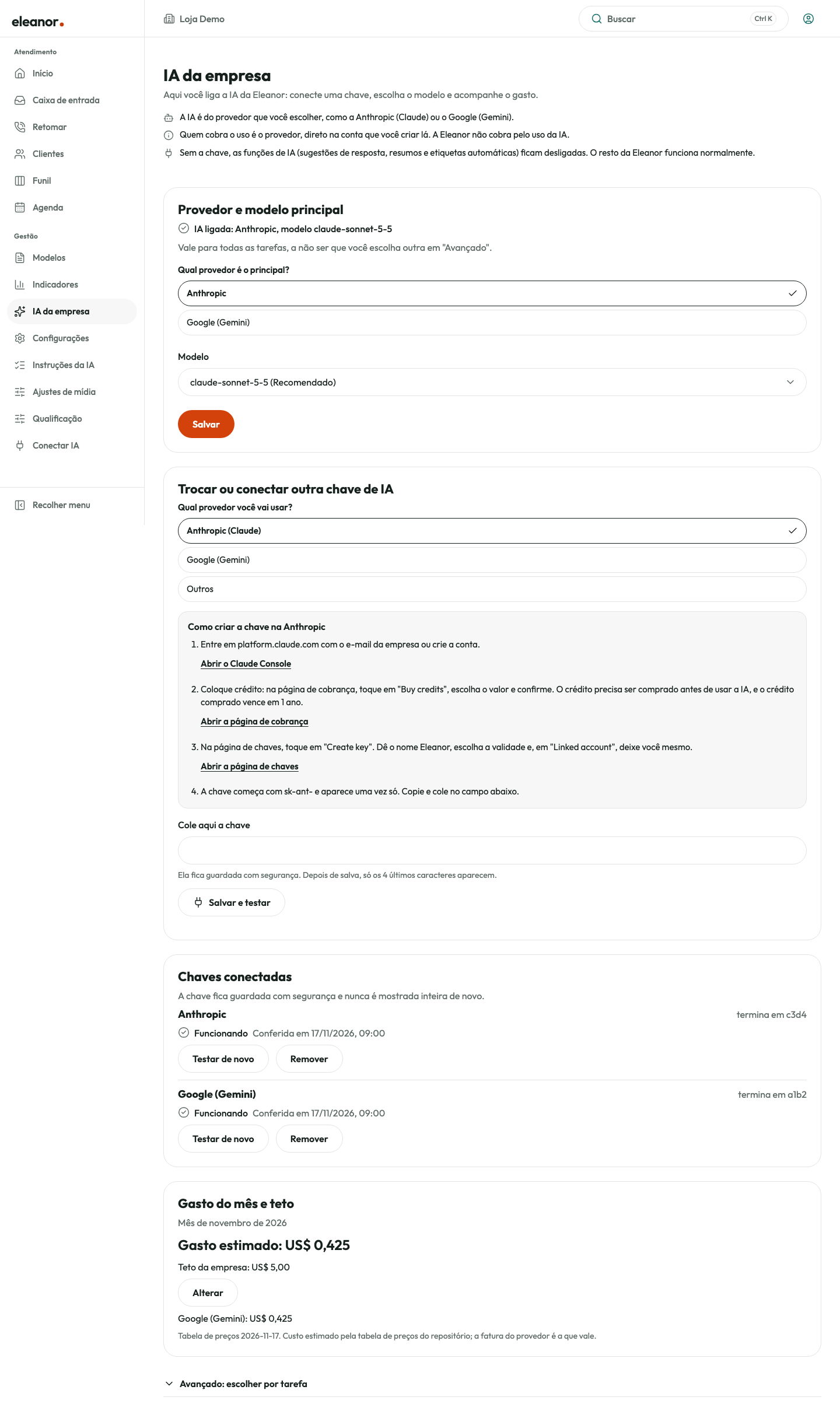
- Platform and AI kept apart: you subscribe to the platform (inbox, pipeline, contact profile, calendar) and the AI runs with your own account key at the provider you pick. The usage shows up on your provider's invoice, token by token, with the public table in front of you: you choose the model, approve a monthly spending cap, and see the real cost of every choice.
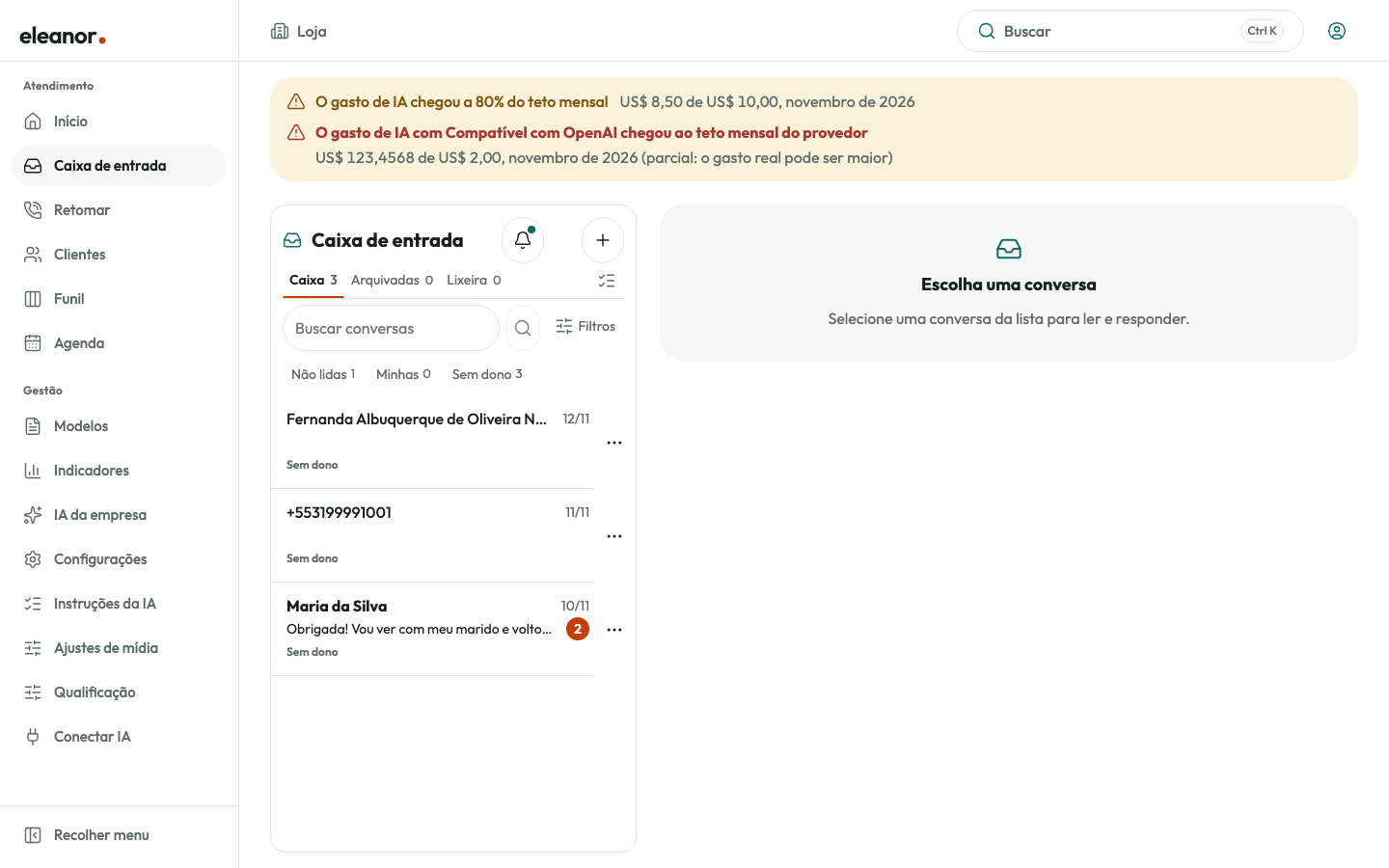
Eleanor follows the second model: you subscribe to the platform; the AI model, usage and spending cap are yours. With no cap approved, the AI doesn't even turn on. This turns AI cost from a mystery number into an owner's decision: want cheaper AI? Switch the model. Want a limit? Approve a cap. Want it off? Turn it off.
Next steps
Tokens stop being intimidating once you look at your own operation: a few thousands per typical conversation, input weighing more than output, caching and batching discounting what repeats, and the public table in front of everything. With those facts, you can estimate your AI cost in an hour of spreadsheet work and demand transparency from whoever sells you AI.
If having the cost in your hands makes sense for your business, put together a quote for the platform: WhatsApp numbers, people on service and contacts, with or without AI.
Answers on this topic
Frequently asked questions
What is an AI token, in practice?
The piece of text the model reads and writes, such as a word, a piece of a word or a punctuation mark. The customer's question and the AI's answer both become tokens, and providers bill per token read and written.
How many tokens does a WhatsApp conversation consume?
A typical service conversation consumes a few thousand tokens, reading and writing combined. Consumption grows with accumulated history, instruction size and the chosen model, not with the number of customers.
Is it worth using my own AI account key?
If you want control, yes: usage shows up on your provider's invoice, you pick the model, approve a spending cap and can turn it off anytime. In the bundled model, those numbers stay inside the vendor's package, and you only see their final price.
More articles

AI in Customer Support: When It Pays Off (and When It's a Waste)
AI in customer service pays off in some businesses and burns money in others. Here's what the research says about when AI pays off, when it's a waste of money, and how to run a one-week test before spending another dollar.
Read article

Your AI's House Rules Matter More Than the Model Behind It
Two businesses run the same AI model; one gets praise, the other sees the AI promise deadlines nobody approved. The difference is the instructions the owner wrote. What OpenAI and Anthropic say about rules, and the minimum set every support AI needs.
Read article
How Much Does a Support AI Cost? The 3 Cost Layers Nobody Explains
Anyone who asks 'how much does a support AI for WhatsApp cost?' hears 'it depends', with no explanation. The bill has three layers: the channel (WhatsApp), the platform that organizes, and the AI usage itself. See what drives each one and the questions to ask before you sign.
Read article