 eleanor
Customer follow-up
Customer stopped replying on WhatsApp? How to follow up
An unanswered quote is not necessarily a lost customer. Use research, context and permission to follow up without pressure, with Eleanor helping draft the message.
You sent a quote. The customer asked about delivery, said they would discuss it with their family and disappeared. Nobody said no. But the conversation slipped down the inbox, and nobody remembers what was left open. A few days later, the business calls it a lost opportunity without really knowing why.
A useful follow-up starts with a different question: is there a legitimate next step for this particular person? If the answer is yes, the new message should show that the team understood the previous one. If there is nothing relevant to add, silence may be the more respectful option.
What research does and does not prove
The Harvard Business Review study on online sales leads published in 2011 examined how quickly businesses contacted people who had submitted inquiries. Firms that attempted contact within one hour were nearly seven times as likely to qualify a lead as those that waited even one hour longer. The study concerned initial response speed on web leads. It did not establish that sending repeated WhatsApp messages days later improves conversion.
There is a second piece of evidence about continuity. In its State of the AI Connected Customer research, Salesforce found that consistent interactions across departments remain a significant customer expectation. That matters when two people take turns answering the same WhatsApp number. The next person should see what the customer already asked, not request the whole story again.
The Zendesk guide to first reply time also distinguishes quick responses from useful responses. Saying hello in seconds without resolving a question is not the same as helpful service. A good follow-up has context and a reason, not just an attractive response-time chart.
These findings support a careful approach to speed and continuity. None gives every business a universal "customers recovered" percentage. Measure that in your own operation instead of borrowing a sales claim from another context.
Which conversations deserve another message?
An open quote. Someone received the proposal and wanted time to think. The next message can ask whether any part needs clarification, without demanding a decision or inventing a discount.
A visit that never happened. A customer wanted an appointment or a demonstration, but it did not happen. You might offer to check other dates if that is still useful and availability can be confirmed.
A question left unfinished. The customer asked about size, delivery or how something works and did not return. Continue from that exact question rather than starting a new generic pitch. Confirm current stock and terms before stating them.
A clear refusal is different. If someone explicitly declined, asked you to stop or has already received several unanswered attempts, the sensible action may be not contacting them. A CRM should make those limits visible, not push staff to maximize sends.
Three examples that respect the customer
For an unanswered quote, try: "Hi! I was looking at our conversation about [item]. Is there anything in the quote I can clarify?". For a missed visit, try: "Hello! We didn't get to meet as planned. If it is still useful, I can check other available times". For a pending question, try: "You had asked about [topic]. Would it help if I confirmed that information with the team?".
Notice what these examples avoid. There is no "you disappeared", invented scarcity, unsupported price promise or pressure to reply today. The customer has room to say yes, no or nothing.
Research published in the Journal of Consumer Research on concrete language connects more concrete language in customer service with greater satisfaction and purchase outcomes, using real interactions and experiments. It does not prove any of the example messages above will close a sale. It does offer a useful direction: refer to the customer's actual concern, not a one-size-fits-all marketing script.
WhatsApp's 24-hour window changes the plan
WhatsApp is not an unlimited outbound messaging channel. The official WhatsApp Business Messaging Policy says a business can send free-form replies within the customer service window, which opens and resets when the customer messages. Outside that 24-hour window, an initiating message must use an approved template and satisfy the relevant policy and consent requirements.
A name appearing on a follow-up list does not grant permission to send an arbitrary message. Staff must check the window, recipient preferences, approved message type and current Meta rules before acting.
What Eleanor does in practice
Eleanor's follow-up queue organizes cases such as unanswered quotes, pending visits and conversations that have gone quiet. Rule-based classification determines why an item is there and whether it needs attention. AI does not invent a customer list or choose whom to message.
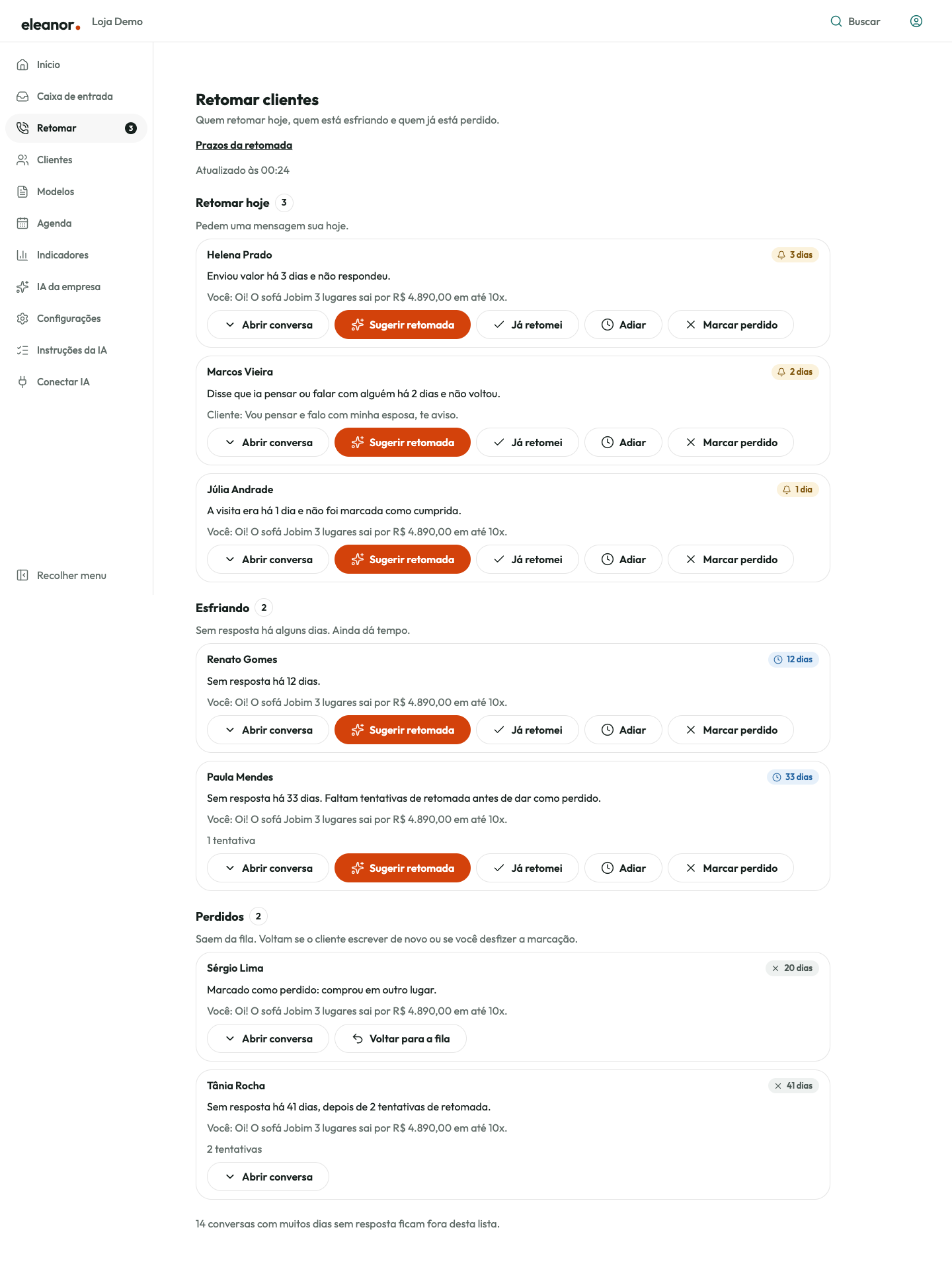
An agent can open a contact and choose Suggest follow-up. Eleanor uses the authorized conversation context and reason for follow-up to draft a relevant message. The person reviews, changes or declines it. The queue also lets the team mark an attempt completed, postpone it or close the case, preserving what happened.
The distinction matters: AI helps understand language and write a draft. The CRM's deterministic rules handle ordering, eligibility and limits. A human remains responsible for the send. This is not a promise that Eleanor automatically runs outbound campaigns whenever somebody becomes inactive.
For team handovers, the customer record and conversation summary help the next agent continue where the last one stopped. The customer gets a connected experience rather than another introduction from someone who has not read the history.
Measure outcomes, not just messages sent
Run a one-week review. Count the conversations entering the queue, those eligible to be contacted, those reviewed by staff, messages actually sent and replies received. Then track what those replies produced: clarification, appointment, confirmed purchase, explicit refusal or a request to stop.
A sent message is not a recovered customer. The response rate is not the sales rate. Results depend on why the contact went quiet, how long ago the last interaction happened and whether the business had something useful to say.
Also track conversations the team decided not to contact. Protecting customer choice is part of a healthy relationship, even though it is not an impressive campaign metric.
Mistakes to avoid
- Blaming a customer for not answering, or demanding a reply.
- Sending the same message to every contact without reading the history.
- Ignoring a refusal, opt-out or repeated unsuccessful attempts.
- Making up stock, delivery promises or urgency to get attention.
- Sending a free-form business-initiated message outside Meta's permitted window.
- Treating a successful message delivery as a completed sale.
A professional follow-up has a purpose, a useful message, permission and a stopping point. More messages are not automatically better service.
Next steps
Pick five stalled conversations and ask what is missing from each one. Choose only the contacts with a legitimate reason to follow up. Draft each message from the original context, check whether WhatsApp permits that kind of send and record the outcome. Use what you learn to refine the workflow.
Eleanor brings the shared inbox, customer context and follow-up queue together. AI prepares the words; people choose how to continue the relationship.
Answers on this topic
Frequently asked questions
When should I follow up with a customer who stopped replying?
When there is a clear pending quote, question or appointment, and the message complies with the contact's preferences and WhatsApp rules. There is no universal magic interval.
Does Eleanor automatically message all forgotten customers?
No. The queue uses rules to identify work, AI can prepare a draft and a person decides whether a message is appropriate.
Can I send any message after 24 hours on WhatsApp?
No. Outside the customer service window, an approved template and the applicable requirements are needed. Check Meta's current policy.
More articles

After-hours WhatsApp support: who replies at 10 p.m.?
A customer messages after closing time. How do you acknowledge their request, preserve the next step and use AI responsibly without promising a 24/7 human team?
Read article
AI Speeds Up the Customer Service You Have, Mess and All
AI in customer service doesn't fix what's broken; it multiplies what's already there. In an organized operation that's speed; in a messy one, the AI just gives the wrong answers faster. The minimum-organization checklist before automating.
Read article
WhatsApp CRM: What It Is and How It Works for Your Business
A WhatsApp CRM is customer relationship management built on top of the chats: one inbox, a customer profile, a funnel and centralized history. See what it is, what it solves, how it works in practice, and when your business needs one.
Read article