 eleanor
Response times
Response time on WhatsApp: why slow replies lose customers
A customer wrote and nobody answered. What research says about first response time, why WhatsApp pushes expectations down to minutes, and how a small business organizes itself to reply fast without being glued to a phone.
From 7:02 p.m. to 7:40 p.m., a customer waited. She had asked whether the model on your site came in another color and what the delivery time was. Since nobody answered, she messaged the competitor, who replied in three minutes. The sale left your hands without you ever finding out. That is how many sales die: not because of price, not because of product, but because of silence.
This article is about the gap between the customer's message and your first reply: what research says, why WhatsApp pushes the expectation down to minutes, what slows a small business down, and how to organize things so customers don't have to wait.
The wait is silent
When service happened only in person, customers waited at the counter and impatience gave fair warning. On WhatsApp, they still walk away, just without a signal: they switch chats, open the competitor's site, ask the family group and buy somewhere else. And they almost never come back to tell you. Nobody writes "I gave up on you because you were slow". From the inside, the week closes with "slow traffic" and nobody names the real cause: an inbox standing still at 7 p.m. on a Tuesday.
What research says about answering fast
It is not a feeling: the gap between a question and the first reply changes the outcome of the sale. A study published in the Harvard Business Review audited more than 2,000 companies to measure how long they took to answer incoming quote requests. The numbers are uncomfortable:
- Companies that tried to contact a lead within one hour were nearly seven times as likely to qualify it as those that tried an hour later and more than sixty times as likely as those that waited 24 hours or longer.
- On average, the audited companies took almost 42 hours to send a first response.
- 37% answered within an hour, but almost a quarter never answered at all.
The study looked at web leads, not neighborhood businesses chatting on WhatsApp. But the logic applies to any counter: interest has an expiration date. The customer researches at night, decides in minutes and buys from whoever shows up first. And the figure that deserves a frame on the wall: nearly a quarter of the companies never responded. If your inbox has messages without a reply from days ago, your business is closer to that group than you think.
Every channel creates a different expectation
An acceptable first response time is not one number: it changes with the channel. Zendesk calls this gap first reply time (the time between the customer's first message and the business's first reply) and treats it as a service metric measured per channel.
And WhatsApp is the most demanding channel on the list: the same person who replies to family in seconds expects the same rhythm from a business. The expectation there is minutes.
There is also a technical limit everyone serving customers on WhatsApp knows the hard way: the 24-hour window from Meta. After a day without a reply, the business must use approved message templates to reach out again. It cannot simply pick the chat up where it stopped. Leaving the customer waiting doesn't only cost you this sale: it also closes the door on free-form conversation.
Why small businesses are slow (it's not lack of care)
Replying fast is not a matter of willpower; it is a matter of structure. The typical routine is one person on service (sometimes the owner) handling everything on a single phone while doing everything else:
- Five chats at once and one person: whoever arrived last, with nobody assigned, is left unanswered.
- The phone that serves is the personal phone: when it stays charging at the counter, goes out with the team or sits through a lunch break, service stops with it.
- No clear ownership: everyone assumes someone else will reply to the new chat, so nobody does.
- Answers that depend on asking around: price, delivery time, stock. Whoever serves has to check with someone else first, and the message sleeps while that happens.
None of these bottlenecks is solved by a "we care about customers" speech. They are all organization problems: who answers what, and with what support. The difference between replying in minutes and replying in hours is almost never typing speed; it's having the right conversation in front of the right person.
Start by measuring the first response
Before changing anything, measure. The first response is the most honest measure of your service, because it doesn't depend on closed deals: it is the time between the customer arriving and the business saying "hi, how can I help?".
The simple way: for one week, note the time of the question and the time of your first reply for ten new chats. You will land in one of three situations:
- Mostly minutes: your structure handles today's volume; the job is keeping it from becoming the bottleneck as volume grows.
- Minutes by day, hours at night: the classic: the business replies well when staffed, and the night customer (who buys a lot) goes unanswered. This is the WhatsApp case.
- Always hours: the bottleneck is structural: one person is a single point of failure, nobody shares the load, answers depend on asking around. More effort won't fix it; it needs organization.
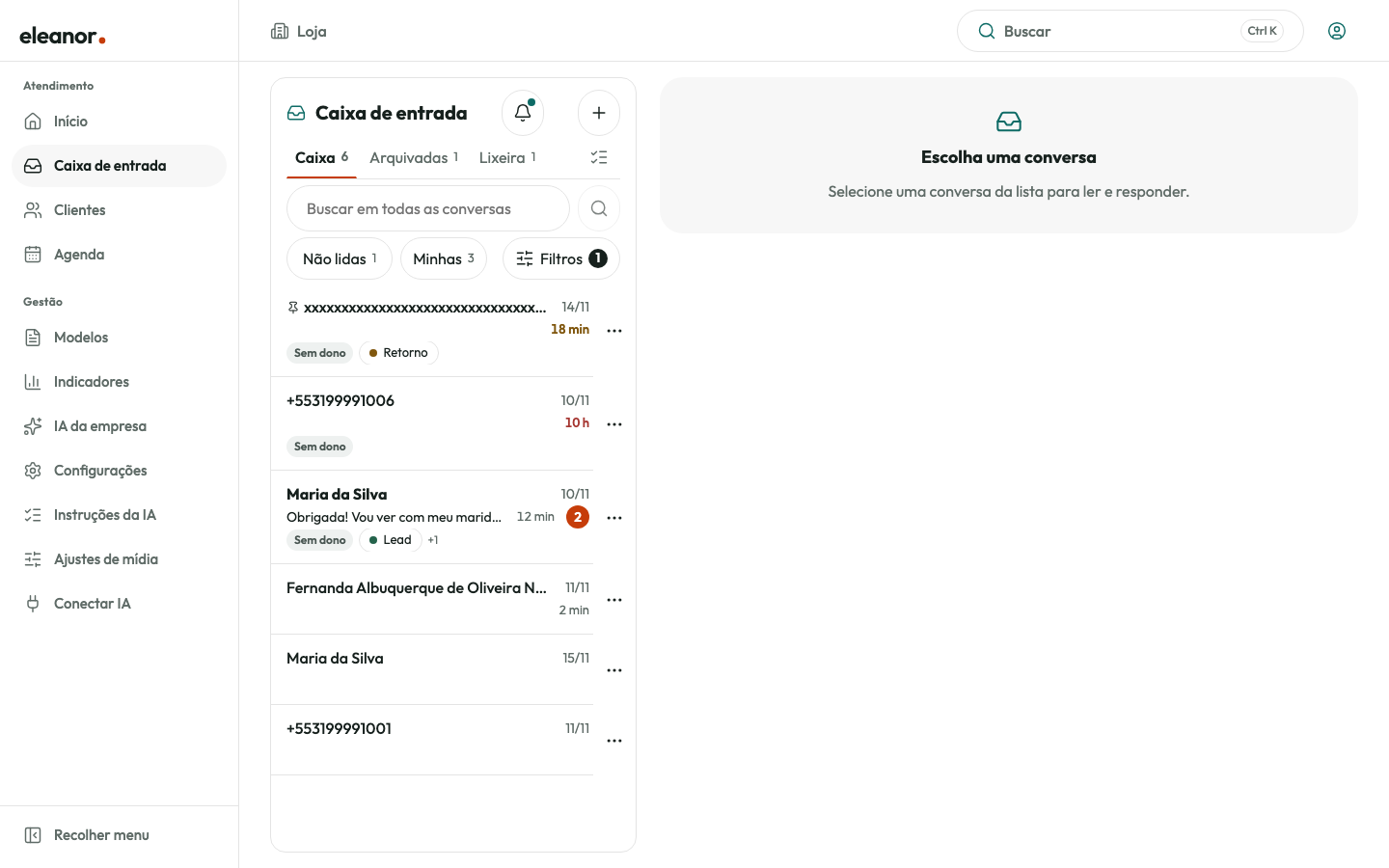
With the measurement in hand: set a realistic target (minutes, not hours), give the new chats an owner whenever the business is open, and treat night messages as an early commitment for the next morning, not as an "I'll check later". The 24-hour window is the reminder that this commitment has a deadline: answered within the day, the conversation stays open and free-form.
Where AI helps and where it stays out
Fast replies don't start with AI; they start with organization: conversations with an owner, history at hand, canned answers for what repeats. Connected to that organization, AI (a true service agent) helps on three fronts: suggesting replies to whoever has five chats open, covering the hours when the team is thin, and not letting a message die out of forgetfulness.
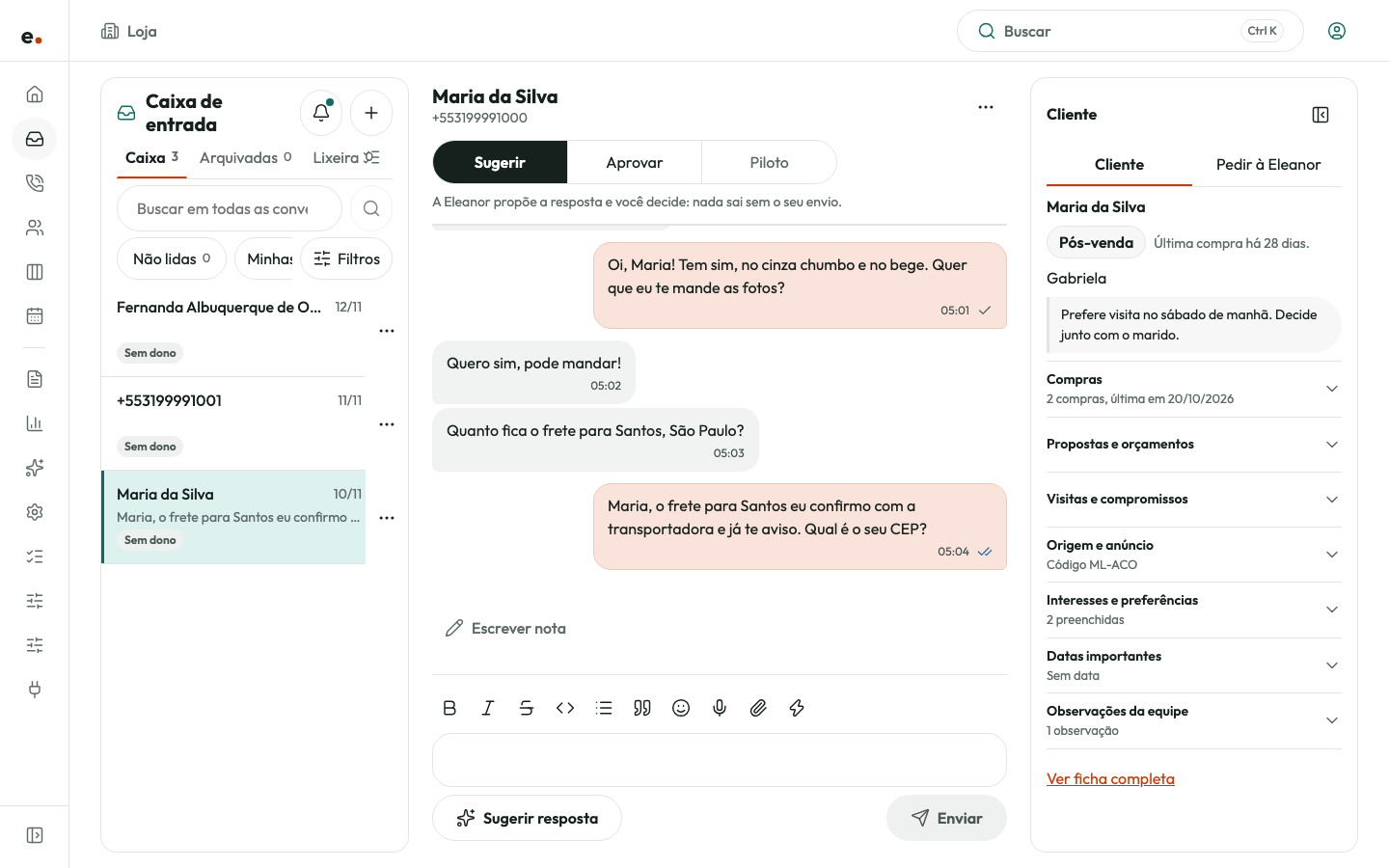
And what decides the sale stays human: price, tight deadlines, complaints, negotiation. Eleanor's service agent works the same way in every mode: it suggests, writes for the team to approve, or replies on its own only in the topics the business allowed. When in doubt, it stops and calls the team. You decide what the AI does.
Next steps
Also see how to follow up without pressure.
If your week of measurement showed customers waiting too long, the path is organization: one WhatsApp inbox, conversations with owners, alerts for whatever stalls, and canned answers for what repeats. With the house in order, the AI agent joins as an assistant, in the mode you choose, with the cost in your hands.
Build a plan the size of your business: WhatsApp numbers, people on service and contacts, with or without AI.
Answers on this topic
Frequently asked questions
What is first response time?
The gap between the customer's first message and the business's first reply in that conversation. It is one of the most honest service metrics, because it doesn't depend on closed sales.
What is a good response time on WhatsApp?
The standard the channel itself created is minutes: customers use WhatsApp for personal conversations and expect the same rhythm. Email tolerates hours; WhatsApp doesn't. Set a minutes-based target for business hours.
Is there research linking slow replies to lost sales?
Yes. A study published in the Harvard Business Review measured companies answering quote requests: replying within an hour meant nearly seven times more chance of qualifying the lead than taking an hour longer, and more than sixty times more than waiting 24 hours or more. On average, the first response took 42 hours.
More articles

Customer stopped replying on WhatsApp? How to follow up
An unanswered quote is not necessarily a lost customer. Use research, context and permission to follow up without pressure, with Eleanor helping draft the message.
Read article

After-hours WhatsApp support: who replies at 10 p.m.?
A customer messages after closing time. How do you acknowledge their request, preserve the next step and use AI responsibly without promising a 24/7 human team?
Read article
AI Speeds Up the Customer Service You Have, Mess and All
AI in customer service doesn't fix what's broken; it multiplies what's already there. In an organized operation that's speed; in a messy one, the AI just gives the wrong answers faster. The minimum-organization checklist before automating.
Read article