


Source-backed AI
Customer service AI that never makes up prices or stock: a rule, not a prompt
Language models sometimes state with confidence things that are not true. In customer service, that becomes a wrong price, a lead time nobody agreed to and a product that does not exist. Why the business answers for what its AI says, and how to add a check that does not depend on the model.
A reliable customer service AI does not answer about price, lead time, stock or payment terms without a source from the company itself. When there is no source, it does not take a chance: it hands the conversation to someone on the team. This is not solved by politely asking the model "not to make things up". It is solved with a rule that checks the answer before it goes out.
This article explains why language models are wrong with confidence, why the mistake belongs to the business and not to the machine, and how to build that check.
Why AI sometimes states what is not true
OpenAI, the company behind ChatGPT, published a piece in 2025 on why language models hallucinate. The definition is direct: hallucinations are plausible but false statements generated by language models. According to the text, they persist partly because training and evaluation tend to reward guessing over acknowledging uncertainty, like a multiple choice test where guessing scores better than leaving the answer blank. OpenAI itself says hallucinations remain a fundamental challenge for all large language models.
In customer service, that has a concrete translation. Ask a model with no access to the company's data whether an item is ready for delivery, and it may say yes, in a nice, confident sentence. The model does not know. It produced the answer that sounds most likely.
The business answers for what its AI says
In February 2024, the Civil Resolution Tribunal of British Columbia, in Canada, decided Moffatt v. Air Canada. A passenger used the chatbot on the airline's website, which told him he could apply after the trip for a reduced bereavement fare. The airline's actual policy did not allow that. Air Canada argued it could not be held liable for what the chatbot said. The tribunal called the argument "remarkable" and wrote that it should be obvious to the company that it is responsible for all the information on its website, whether it comes from a static page or a chatbot. The airline was ordered to pay the fare difference, with interest and fees.
Eleanor was born in Brazil, where the same principle has a direct parallel. Brazil's Consumer Defense Code, in article 30, says that any sufficiently precise information about products and services, conveyed by any form or means of communication, binds the supplier who conveys it and becomes part of the contract. A price given on WhatsApp is information conveyed. This article is not legal advice, and other countries have their own rules, but the warning is clear: a wrong price stated by the AI is not the AI's mistake.
Why "do not make things up" in the prompt is not enough
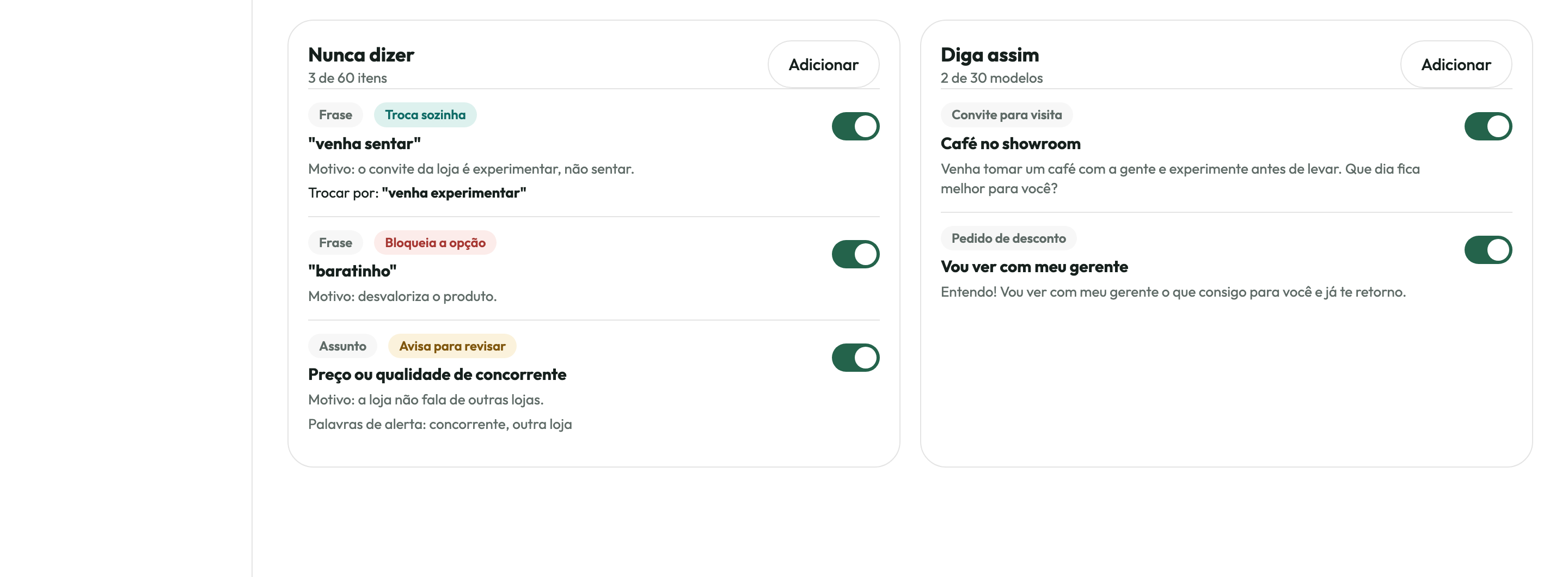
The first reaction is usually to write in the AI's instructions: "never make up prices". Instructions help, and good instructions are part of the job, as we show in house rules for your customer service AI. But an instruction is a request, not a guarantee. The same reason that makes the model hallucinate makes it, every now and then, ignore the request.
That is why the check has to sit outside the model: a deterministic step, which always runs the same way, between the generated answer and the message sent to the customer. It does not interpret, does not negotiate and does not have moods. It checks.
How a source check works
The idea fits in four rules:
- Commercial data only with a source. Price, lead time, payment terms, availability and opening hours can only go out if they come from a company record, such as a catalog, price list, schedule or knowledge base, and the answer keeps track of which record it used.
- Stock checked at the moment of sending. If the team approves a suggestion hours later, availability is checked again at that moment. What was available in the morning may not be in the afternoon.
- Item unavailable: an available alternative, or the team. When what the customer asked for is out of stock, the AI offers alternatives that are available. With no alternative, the conversation goes to a person.
- No source, no answer. When in doubt, the AI does not guess. It alerts the team, and the customer gets a human answer.
The WhatsApp Business Policy points the same way: it allows automated replies within the 24-hour window, but requires prompt, clear and direct escalation paths to a human agent.
What the check does not solve
A source check is only as good as the source. If the price list is out of date, the AI will repeat the outdated price with total confidence, only now with a source. Before turning on any automation, the business needs a single, current version of what is true: catalog, prices, lead times, hours. It is the same starting point as organizing customer service before automating.
And the check does not replace the team's judgment in negotiations, complaints or unusual cases. It ensures the AI does not make things up; it does not ensure the AI decides well what is a decision for people.
Where Eleanor comes in
Eleanor is a customer service CRM for WhatsApp with an AI agent built in, and the four rules above are not settings: they are part of the product, written as tested code, and no company can turn them off. Price, lead time, terms, availability and hours only go out with a company record cited in the decision. Stock is checked at sending time, including when someone on the team approves hours later. Without a source, the AI does not answer and calls the team. And every AI decision is recorded with input, sources, model, cost and outcome, so the business owner can check what was said and why.
Next steps
Run a test with the AI you use today or plan to use: ask for the price and availability of an item that does not exist in your catalog. If it answers confidently, you found the risk before your customer did.
Answers on this topic
Frequently asked questions
Why does AI make up prices or lead times?
Because language models generate the most likely answer, not the true one. OpenAI describes these hallucinations as plausible but false statements and says they persist partly because training rewards guessing over admitting uncertainty.
Is a company responsible for what its chatbot says?
In Moffatt v. Air Canada, in 2024, a Canadian tribunal decided it is: the company is responsible for all the information on its own website, including what the chatbot says. In Brazil, article 30 of the Consumer Defense Code says that sufficiently precise information about a product or service binds the supplier.
Does writing "do not make things up" in the AI's instructions solve it?
It helps, but it does not guarantee anything. The reliable check is a deterministic step outside the model that confirms price, lead time, stock and terms came from a company record before the message goes out.
Sources
- OpenAI, "Why language models hallucinate", 2025: openai.com, read on November 24, 2026.
- Civil Resolution Tribunal (British Columbia), Moffatt v. Air Canada, 2024 BCCRT 149: decisions.civilresolutionbc.ca, read on November 24, 2026.
- Brazil, Law 8,078/1990 (Consumer Defense Code), consolidated text in Portuguese: planalto.gov.br, read on November 24, 2026.
- WhatsApp, Business Policy: whatsappbusiness.com/policy, read on November 24, 2026.
More articles
AI in Customer Support: When It Pays Off (and When It's a Waste)
AI in customer service pays off in some businesses and burns money in others. Here's what the research says about when AI pays off, when it's a waste of money, and how to run a one-week test before spending another dollar.
Read article

Your AI's House Rules Matter More Than the Model Behind It
Two businesses run the same AI model; one gets praise, the other sees the AI promise deadlines nobody approved. The difference is the instructions the owner wrote. What OpenAI and Anthropic say about rules, and the minimum set every support AI needs.
Read article
How Much Does a Support AI Cost? The 3 Cost Layers Nobody Explains
Anyone who asks 'how much does a support AI for WhatsApp cost?' hears 'it depends', with no explanation. The bill has three layers: the channel (WhatsApp), the platform that organizes, and the AI usage itself. See what drives each one and the questions to ask before you sign.
Read article