


Acquisition cost
Customer acquisition cost: how customer service wastes the lead you already paid for
What customer acquisition cost (CAC) is, how to calculate it without fooling yourself, and why the WhatsApp chat nobody answered is the most expensive way to lose ad money.
Customer acquisition cost (CAC) is how much a business spends, on average, to win each new customer: everything invested in marketing and sales over a period, divided by the number of customers won in that same period. It sounds like a marketing spreadsheet number, but the team that moves it every day is customer service. Each person who messages you on WhatsApp after seeing an ad has already cost money. If nobody answers, the cost stays and the customer never arrives.
How to calculate customer acquisition cost
The formula published by Sebrae, the Brazilian small business support service, is direct: CAC = total invested to win customers / number of customers acquired, over the same period. Sebrae adds two caveats that change the result:
- Only spending made directly to win customers counts, which usually means marketing and sales: ads, commissions, prospecting tools, the time of the people who sell.
- Left out are administrative costs, customer support (SAC, in Brazil) and product development.
If one month the spending is the same as the month before and new customers drop by half, CAC doubles, even if the ad brought in exactly the same number of conversations.
This is where customer service enters the math.
CAC rises when the paid conversation does not become a customer
The denominator of the formula is customers won, not contacts received. An ad can deliver the same volume of conversations two months in a row while CAC changes a lot, just because the service team converted fewer of them. What happens after the click decides whether that money becomes a customer or a loss.
The most cited research on this was published in the Harvard Business Review in 2011. The authors audited 2,241 companies in the United States, sending a test inquiry through each company's website. 37% replied within an hour, 24% took more than 24 hours and 23% never replied. Among those that replied within 30 days, the average was 42 hours.
In a second study, covering 1,250,000 leads received by 42 companies, those that tried to reach the prospect within the first hour were nearly seven times more likely to have a meaningful conversation with a decision maker than those that tried an hour later, and more than sixty times more likely than those that waited 24 hours or longer.
The data refers to web leads in the United States, not WhatsApp chats. But the logic holds for any business that pays to be contacted: interest cools fast, and the money spent to generate that contact does not come back.
Where the paid lead gets lost on WhatsApp
Businesses that advertise with a WhatsApp button usually lose the lead at four points, almost always without noticing:
- Nobody saw the message. It landed on the phone of someone busy with another task, or in the middle of ten conversations that were already open.
- Everyone thought someone else had replied. Without a defined owner, the new conversation belongs to no one.
- The answer depended on checking something. Price, lead time or availability sat with another person, and the conversation went cold while someone asked around.
- Nobody followed up. The customer asked for time to think and the chat slid down the list until it disappeared.
None of these points shows up in the ad report, which counts clicks and conversations started but does not know whether anyone replied. So CAC goes up and the ad becomes the first suspect, when the leak is on the inside.
Knowing which ad each conversation came from
To connect spending to results, you need to know where each conversation came from. On the WhatsApp Business Platform, Meta's documentation describes that a message sent by someone who tapped a click to WhatsApp ad arrives with a referral block that identifies the ad, including the ad ID and the click ID. The same page notes an exception: when the message comes from an ad in WhatsApp Status, the click ID is omitted.
In practice, this lets you separate conversations that came from ads from those that arrived through referrals or your profile, and compare what happened to each group. Without that split, CAC becomes an average that mixes everything and does not point to where to act.
A measurement plan for next month
You do not need a new system to start. For one month, record for each conversation that came from an ad:
- The time the customer wrote and the time of the first reply. This shows whether the problem is speed.
- Who owned it. A conversation without an owner is the first to get lost.
- The outcome. Became a customer, asked for time, gave up, never wrote back.
- Whether there was a follow-up. Did the person who asked for time get a later contact with a useful next step?
At the end of the month, calculate CAC twice: once with all customers won, and once imagining that the unanswered conversations had converted at the same rate as the answered ones. That second number is an estimate, not a promise, and it should not go into a report as a result. It shows the size of the leak.
Where Eleanor comes in
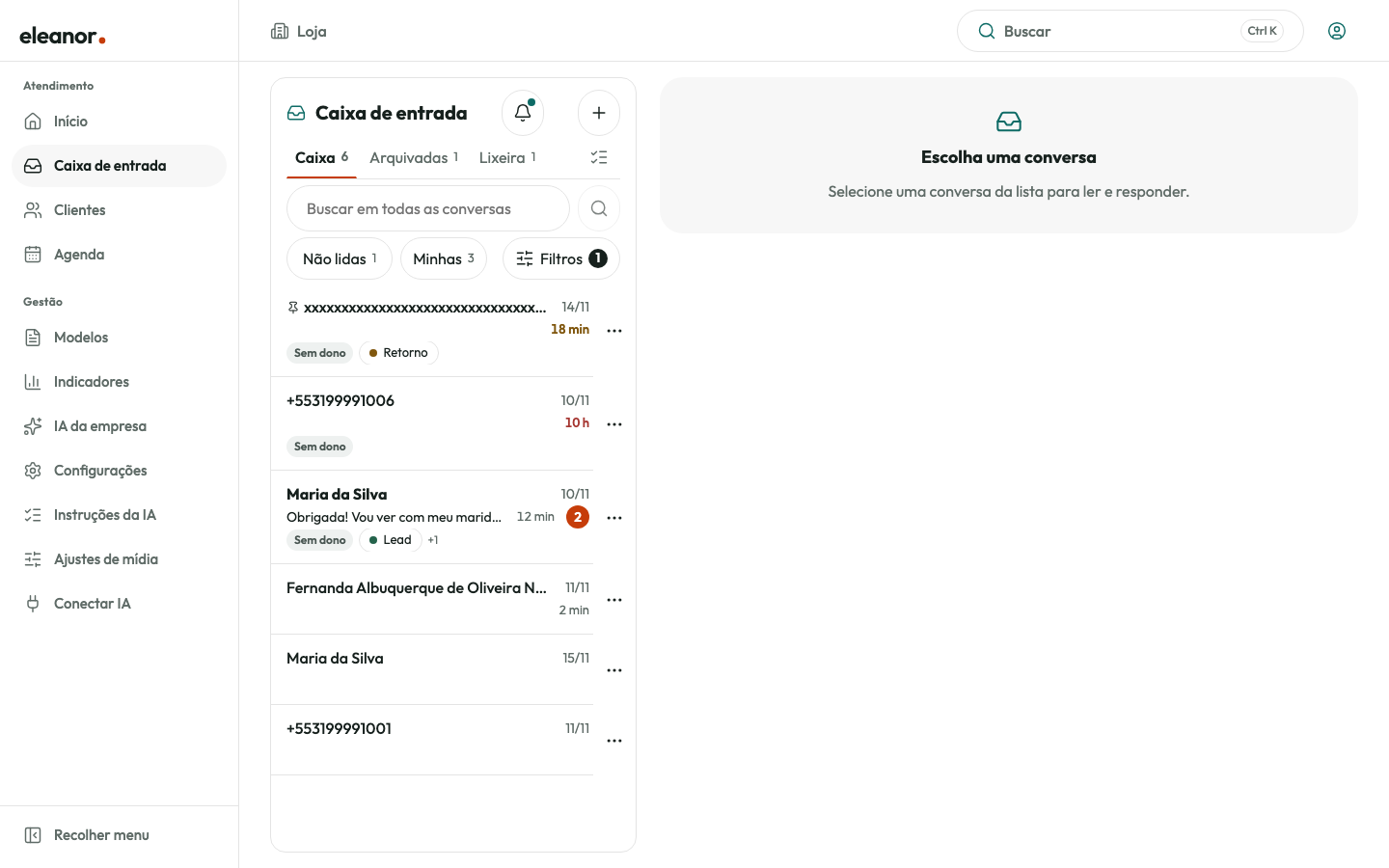
Eleanor is a customer service CRM for WhatsApp with an AI agent built in. Its work starts when the conversation reaches the inbox, which is exactly the stretch where the paid lead usually gets lost. A new conversation shows up in an inbox shared by the team, with an owner, history and waiting time. Whoever asked for time goes into the follow-up queue, with the reason for the pending item. And the AI, when the business wants to use it, helps answer fast in the modes the company allows, without making up prices or lead times: anything without a source in the company's records goes to a person on the team.
Next steps
Run the one-month measurement before touching the ad. If the loss is in customer service, start with the basics: every conversation with an owner, a reply on the same day and a follow-up for whoever asked for time. For the speed side, also read why slow replies lose customers and how to follow up when a customer stops replying.
Answers on this topic
Frequently asked questions
What is customer acquisition cost?
It is how much a business spends, on average, to win each new customer. You add up what was invested in marketing and sales over a period and divide by the number of customers won in the same period.
Does customer service cost count toward CAC?
Under the definition published by Sebrae, only spending tied directly to winning customers counts, usually marketing and sales. Administrative, customer support and product development costs are left out. If your team sells over WhatsApp, the time it spends selling usually counts as a sales cost.
Why does CAC rise if the ad keeps bringing the same number of conversations?
Because the denominator is customers won, not conversations received. If the team replies late, leaves conversations without an owner or does not follow up with people who asked for time, fewer conversations become customers and each customer costs more.
How do I know which conversations came from ads?
On the WhatsApp Business Platform, a message from someone who tapped a click to WhatsApp ad arrives with a reference to the ad, according to Meta's documentation. A customer service platform connected to the official API can store that origin with the conversation.
Sources
- Sebrae, "CAC: custo de aquisição de cliente" (in Portuguese): sebraepr.com.br, read on November 24, 2026.
- Oldroyd, McElheran and Elkington, "The Short Life of Online Sales Leads", Harvard Business Review, 2011: hbr.org, read on November 24, 2026.
- Meta, WhatsApp Business Platform messages webhook reference: developers.facebook.com, read on November 24, 2026.
More articles

Reactivating customers on WhatsApp: how to reach a dormant customer base without spamming
A customer who bought once and disappeared is the easiest conversation to restart, and also the easiest to ruin. When to reach out again, what WhatsApp rules and data protection law require, and how to write a message people actually want to get.
Read article
No-shows: how to reduce missed appointments with WhatsApp reminders
A booked slot and a customer who never shows up cost the team's time and a slot someone else wanted. What research says about message reminders, how to set up a reminder on WhatsApp and what to do with people who missed.
Read article
WhatsApp with multiple agents on one number: split the work, lose no chats
One number, several people replying and nobody knowing who took what. The options for putting more than one person on the same WhatsApp, the limits of each one and the rules that prevent forgotten customers and double replies.
Read article