


Support metrics
WhatsApp customer service metrics: the numbers that show where sales are lost
Measuring customer service does not require a fancy dashboard. It requires choosing a few numbers, measuring them the right way and looking at them every week. Which metrics matter for businesses that serve and sell on WhatsApp, and how to calculate each one.
The customer service metrics that matter most for businesses selling on WhatsApp are few: time to first response, how many conversations went unanswered, how many were resolved without back and forth, how many stalled conversations were followed up and how many became sales. Measured the right way and reviewed every week, they show where customers give up, which is the first place worth fixing.
This article explains each one, how to calculate it and the measurement mistakes that make the number lie.
Before the metrics: three measurement decisions
The Zendesk guide on first reply time offers two precautions that apply to almost every customer service indicator:
- Measure in business hours. If a customer writes on Friday at 4:58 p.m. and the team replies on Monday at 10:03 a.m., counting the whole weekend distorts the number, since the business was closed. Measure in working hours and make your hours clear to customers.
- Use the median, not the average. A very fast or very slow case pulls the average away from what is normal. The median, the middle value, better shows what the typical customer experiences.
The third decision is yours: measure weekly, always the same way. A single number says little. The same calculation, done the same way every week, shows whether the operation is improving.
1. First response time
The interval between the customer's first message and the business's first reply. Zendesk defines first reply time as the time it takes the support team to respond to a customer request. It is the most honest metric to start with, because it does not depend on closed sales and directly exposes the bottleneck in the team.
As for why this number weighs so much, research published in the Harvard Business Review found that companies that tried to make contact within an hour were nearly seven times more likely to have a meaningful conversation with a decision maker than those that tried an hour later. More details in why slow replies lose customers.
2. Unanswered conversations
How many conversations ended the day without any reply from the business. In the same Harvard Business Review research, 23% of the 2,241 companies audited never replied to the test inquiry. No response time average shows that group, because an unanswered conversation has no response time. That is why it deserves a number of its own.
How to measure it: at the end of the day, count the conversations that came in and got no reply. A healthy target is close to zero during business hours.
3. First contact resolution
How many questions were resolved in the first reply, with no back and forth. The same Zendesk guide notes that replying fast is essential but that what you say matters just as much, and calls a useful answer on the first try first contact resolution. A fast but empty reply improves the first metric and worsens this one.
How to measure it: in a weekly sample of conversations, mark whether the main question was resolved in the team's first reply.
4. Follow-up rate
Of the conversations that stopped with something pending, such as a quote sent, a visit booked or an open question, how many received a useful new contact within the deadline the team set. It measures whether the business gets back to people who asked for time, which is where many sales die from forgetting. The care described in how to follow up without pressure applies here: following up means offering a next step, not demanding an answer.
5. Conversion by source
How many conversations became sales, split by source: ads, referrals, profile, returning customers. The split matters because each source has a different cost. An ad conversation with no reply is money already spent, as we show in customer acquisition cost.
A number that comes from outside: your number's quality
Businesses using the official WhatsApp API have one more indicator to watch, which belongs not to the business but to Meta. The messaging limits documentation shows that raising the limit on business-initiated messages depends, among other conditions, on sending templates with a high quality rating, and that Meta reviews message quality before approving the increase. And the WhatsApp Business Policy notes that unsolicited messages increase the risk of people blocking the business. One more reason to measure follow-up and reactivation carefully, and not by volume.
What not to measure (yet)
Avoid indicators that depend on data you do not have. Satisfaction without a real survey, a "delight rate", the number of messages sent as a sign of productivity: all of these either have no source or reward the wrong behavior. Start with the five above. When they are stable, add what is missing.
Where Eleanor comes in
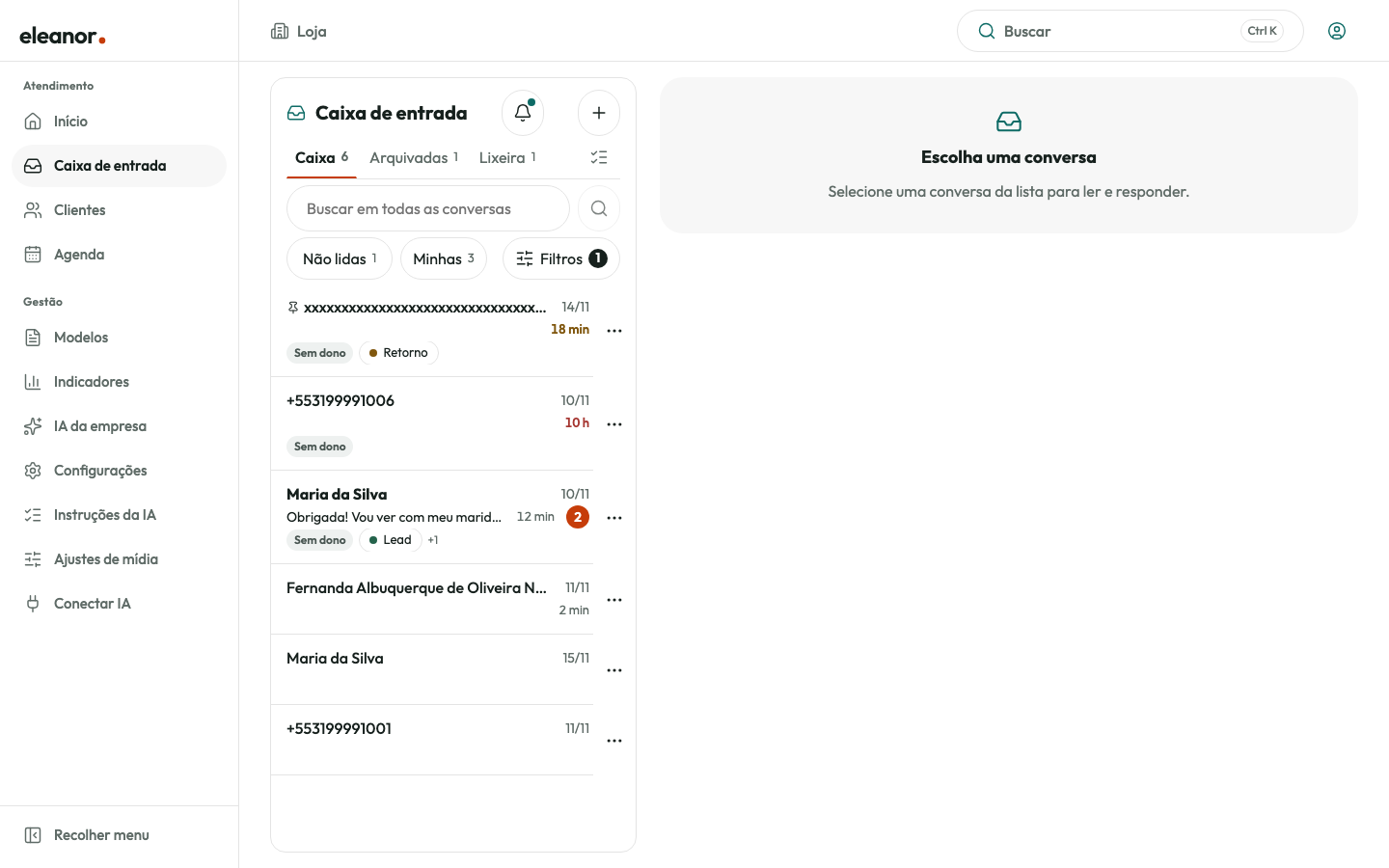
Eleanor is a customer service CRM for WhatsApp with an AI agent built in. Because conversations go through the shared inbox, with an owner and history, the data for these metrics comes from the team's own work, with no parallel spreadsheet: each conversation's waiting time, what went unanswered, what is in the follow-up queue. And when the AI takes part, every decision it makes is recorded with input, sources, model, cost and outcome, so the business owner can check what was done.
Next steps
Choose two metrics to start, first response time and unanswered conversations, and measure them for four weeks, always the same way. Only then change the process and see whether the number moved.
Answers on this topic
Frequently asked questions
What are the most important customer service metrics on WhatsApp?
For businesses that sell, five cover the essentials: first response time, unanswered conversations, first contact resolution, follow-up rate and conversion by source.
Should I use the average or the median for response time?
The median. The Zendesk guide recommends the median because it controls for extreme cases, very fast or very slow, that distort the average. Also measure in business hours, without counting the time when the business is closed.
Is replying fast enough?
No. Speed without a useful answer creates back and forth and solves nothing. That is why first response time should be read together with first contact resolution.
Sources
- Zendesk, "First reply time: 9 tips to deliver faster customer service": zendesk.com, read on November 24, 2026.
- Oldroyd, McElheran and Elkington, "The Short Life of Online Sales Leads", Harvard Business Review, 2011: hbr.org, read on November 24, 2026.
- Meta, WhatsApp Business Platform messaging limits: developers.facebook.com, read on November 24, 2026.
- WhatsApp, Business Policy: whatsappbusiness.com/policy, read on November 24, 2026.
More articles

Customer acquisition cost: how customer service wastes the lead you already paid for
What customer acquisition cost (CAC) is, how to calculate it without fooling yourself, and why the WhatsApp chat nobody answered is the most expensive way to lose ad money.
Read article

Reactivating customers on WhatsApp: how to reach a dormant customer base without spamming
A customer who bought once and disappeared is the easiest conversation to restart, and also the easiest to ruin. When to reach out again, what WhatsApp rules and data protection law require, and how to write a message people actually want to get.
Read article
No-shows: how to reduce missed appointments with WhatsApp reminders
A booked slot and a customer who never shows up cost the team's time and a slot someone else wanted. What research says about message reminders, how to set up a reminder on WhatsApp and what to do with people who missed.
Read article